
STARMILE — Professional Fiber & Cabling Manufacturer
Fiber optic cables have a reputation for their prolonged lifespan, low maintenance need, and dependable quality. From FTTH optics to industrial applications, backbone transmission, and cloud data centers, fiber cables can last for decades under appropriate installation and handling.
So, how often do fiber optical cables need to be replaced?
It depends on several technical and environmental factors. Here is a transparent engineering assessment:
■Typical Service Life of Fiber Optic Cables
Under typical conditions, high-quality fiber optic cables like ZION’s can last:
- 25–50 years for outdoor installed loose tubes
- 15–30 years for indoor cabling
- 10–20 years for heavy-duty indoor/industrial installations
Most fiber cables have a lifespan longer than connected equipment. They are replaced due to system upgrade and not damage.

■ Factors That Determine Replacement Frequency
Different fiber structures have different life expectancies:
| Cable Type | Typical Lifespan | Notes |
|---|---|---|
| ADSS Cable | 25–40 years | Designed for aerial power lines and withstands mechanical load. |
| OPGW Cable | 30–50 years | Same lifespan as overhead ground wires. |
| Duct / Direct-Buried Cable | 25–40 years | Protected from UV and mechanical stress. |
| Drop Cables (FTTH) | 10–20 years | Exposed to UV and bending from customer drops. |
| Indoor Tight-Buffered Cable | 15–30 years | Lower environmental stress. |
■ Cable Lifespan Factors
Technical Factors
Manufacturers state expected lifespan under optimal installation and handling:
- Outside plant composite armor for outdoor applications: 50 years
- UV-resistant LSZH for outdoor indoor use: 30 years
- Industrial app with rugged ude: 15 years
Environmental Conditions
Unfavorable conditions shorten cable lifespan:
- Extreme temperature swing: −40°C to +70°C fog/transportation
- UV exposure: aerial FTTH installations
- Humid/sea mist: installed close to coastal regions
- Hazardous chemicals: industrial environment
- Rodent attack: underground wiring
Armor, LSZH, UV repellent, rodent-proof, or seismic design can dramatically enhance cable durability.
Installation & Handling
One of the highest replacements cause is improper installation or handling:
- Over-tension pulled
- Excessive nighttime or bending area
- Cable crushed by contractors (civils)
- Poor splice joint bonding
- Water migration in cable (seal integrity)
Professionally handled cable like ZION’s ADSS, outdoor, FTTH, duct, and wall wiring can serve for decades.
System Upgrades
Elementary system upgrades cause cabling replacements:
- GPON → convert to XGSPON → 50G-PON
- 6 core → 12 core → 40 core → 144 core
- Enterprise-tuple cloud platforms: 10G → 40G → 100G → 400G
- Replace copper wiring in a building with fiber
Cable still works, but the wiring system need more capacity.
■ When Should You Replace Fiber Optical Cables? (Indicators)
- 1. Regular attenuation (loss) issues
Detectors show higher than normal reception and reflection incidents for splices. - 2. Water migration (seal failure)
Moisture enters the cable Indian fiber glue. - 3. Sheath ERU or UV embrittlement
Typical on old FTTH drop cables (close building sides) - 4. Mechanical damage – rodent or crushed
Rodent bait outdoors, construction on roadsides. - 5. Mechanical cable systems failure (ADSS, OPGW)
Strain members for aerial installations. - 6. Network upgrade needs cable service changes
Example: upgrade from standard G.652.D to bendable G.657A2 indoors, in-depth wall installations.
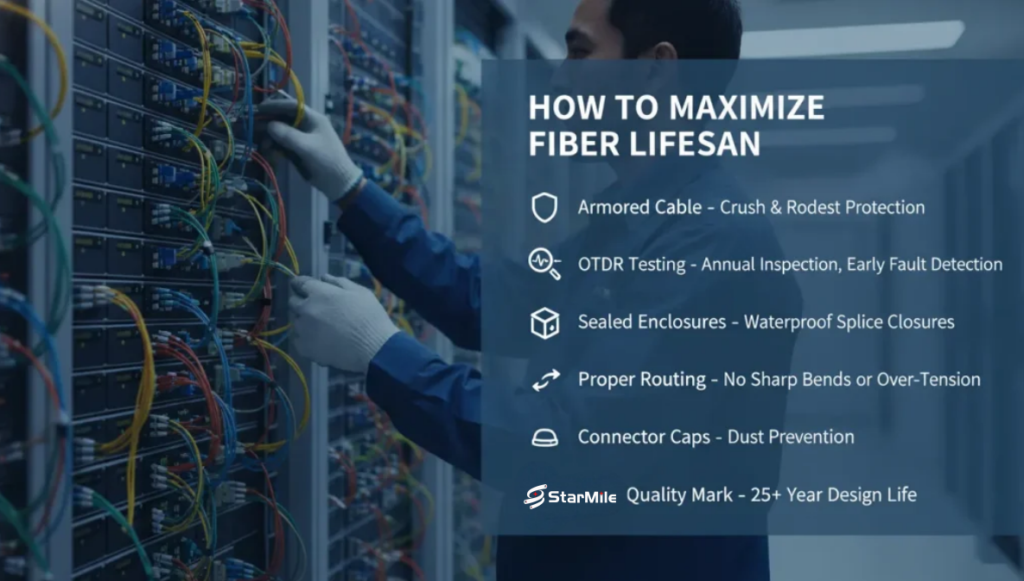
■ How to Improve Cable Lifespan?
STARMILE recommends:
- Use effective sheath protection against conditions.
- Use armored cable to protect internal cable.
- Follow cable installation and handling layout.
- Use fiber connectors (SC/LC/MPO) and splice protectors.
- Keep regular cable inspection. OTDR 1–2 years intervals.
- Control the cable seals around closures.
- Avoid construction trades overloads in poles/ducts.
Polymer cables like outdoor FTTH drops can have 20+ years performance.
■ Final Answer – How Often Should Fiber Optic Cables Be Replaced?
Most Fiber cables don’t Need to be Replaced.
If installed and protected correctly against technical and environmental conditions, they can last:
25–50 years (outdoor plant infrastructure, long-haul wiring)
15–30 years (indoor building wiring systems)
10–20 years (FTTH plant drop near customer premises)
Optics are durable, reliable, thermal set and also a future-proof investment!