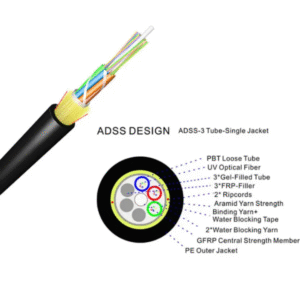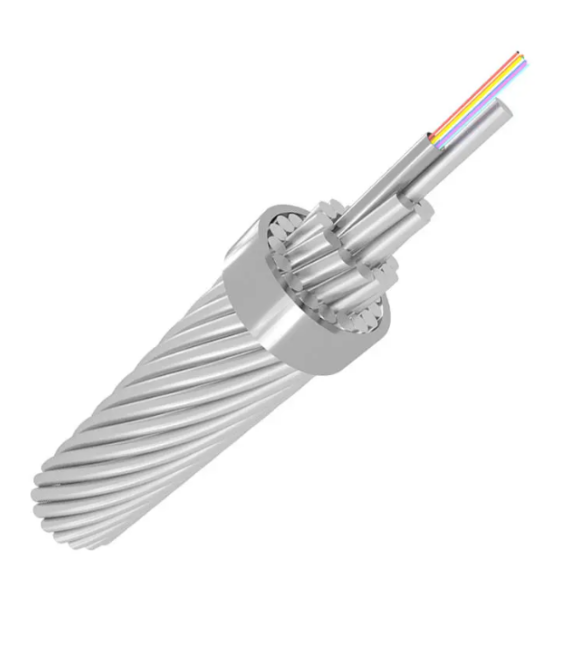
Typical Designs of OPPC
The Aluminium tube is surrounded by single or double layers of aluminium clad steel wires(ACS) or mix ACS wires and aluminium alloy wires.
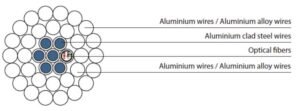
■ Characteristic and Application:
- Replacing one or several wires of the traditional conductor with stainless steel tube and strand the tube with AS/steel wires and AL/AA wires.
- Replacing one of the three phase conductors with OPPC, thus to form a transmission line which consists of one OPPC and two phase conductors.
- Mechanical and electrical performance can match the adjacent two phase conductors.
- OPPC can meet durative high temperature resistant which verified by Temperature Cycling test and Short Current test.
- OPPC is applied to middle & high voltage power lines without ground wires such as 10kV, 35kV, 66kV and so on.
- Telecommunications for middle & high voltage power lines in urban and rural areas; Providing optical cables for building distribution automation station.
■ Typical Parameters:
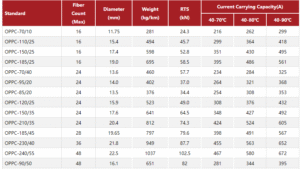
OPPC Cable Summary
- Fiber Count & Max Configuration:
- Cables typically range from 16 to 48 fibers, depending on the model.
- Cable Diameter:
- Diameters range from 11.75 mm to 22.5 mm, with the smallest cables being those with 16 fibers (OPPC-70/10) and the largest having 48 fibers (OPPC-240/55).
- Cable Weight (kg/km):
- Cable weights vary significantly, from 281 kg/km (OPPC-70/10) to 1037 kg/km (OPPC-240/55). Heavier cables generally have more fibers and larger diameters, which correspond to higher strength and greater electrical capacity.
- Tensile Strength (RTS in kN):
- Ranges from 24.3 kN (OPPC-70/10) to 102.5 kN (OPPC-240/55). This indicates the maximum force the cable can withstand before breaking. Larger diameter cables tend to have higher tensile strength, making them more suitable for areas with higher mechanical stress.
- Current Carrying Capacity (Amperage):
- OPPC-70/10: 216-299 A (depending on temperature)
- OPPC-110/25: 299-418 A
- OPPC-150/25: 351-495 A
- OPPC-185/25: 395-561 A
- OPPC-230/40: 455-652 A
- OPPC-240/55: 467-672 A
- Varies based on the cable size and fiber count:
- Current carrying capacity increases with the cable size and the number of fibers. The amperage varies slightly based on the temperature (40-70°C, 40-80°C, 40-90°C), with higher temperatures generally resulting in a decrease in current capacity.
General Trends:
- Smaller cables (e.g., OPPC-70/10): Lower fiber count, smaller diameter, lighter weight, and lower tensile strength, but suitable for lower current applications.
- Larger cables (e.g., OPPC-240/55): Higher fiber count, larger diameter, heavier weight, and significantly higher tensile strength and current carrying capacity, making them ideal for areas requiring more power transmission and mechanical durability.
■ Packaging and Drum:
1.Cable Sheath Marking
Unless otherwise specified, the cable sheath marking shall be as follows:
Color:White
Contents:ZION, the year of manufacture, the type of cable, cable number, length marking Interval: 1±0.2% m
Outer sheath marking legend can be changed according to user’s requests.
2.Reel Length
Standard reel length: 2/3 km/reel, other length is also available.
3.Cable Drum
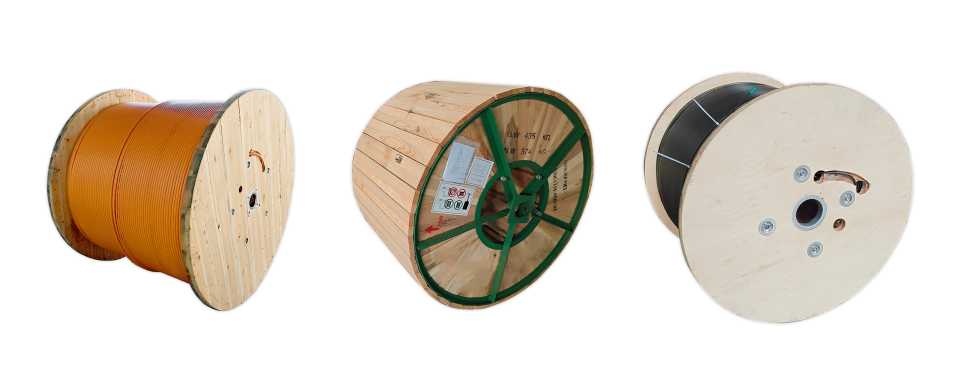
The cables are packed in fumigated wooden drums or plywood drums.
4.Cable Packing
Both ends of the cable will be sealed with suitable plastic caps to prevent the entry of moisture during shipping, handling and storage. The inner end is available for testing.