
The Rise of Tethered Drones
Over the past decade, tethered drones—UAVs connected to a ground station through a cable—have transformed from niche defense tools into mainstream industrial platforms.
Unlike traditional battery-powered drones, tethered systems can stay airborne for hours or even days, enabling continuous aerial surveillance, broadcasting, or communication.
Why the World Is Turning to Tethered UAVs
Modern industries and governments increasingly rely on persistent aerial coverage:
- Urban Security & Surveillance: Smart city monitoring and large-event crowd control.
- Border Patrol: Continuous area monitoring where wireless drones would quickly lose power.
- Emergency Communication: Rapid deployment of temporary 5G or LTE coverage during disasters.
- Sports & Live Broadcasting: Stable, high-resolution aerial shots with zero transmission lag.
These applications all share the same demand — uninterrupted power and high-bandwidth data — exactly where fiber optic tether systems excel.
The Challenge: Power & Data Transmission Limitations
⚡ The Weakness of Standard Wireless Drones
Conventional drones, even those using 5G or Wi-Fi links, face severe limitations:
- Limited Flight Time: 20–40 minutes due to battery constraints.
- Unstable Connectivity: Wireless signals degrade in dense environments.
- Latency & Interference: Real-time video transmission suffers from delays and weather effects.
- Data Bottlenecks: 4K/8K video or sensor data exceeds typical wireless bandwidth.
💡 Why “Fiber + Power” Is the Next Step
A hybrid fiber optic tether integrates both electrical conductors and optical fibers, creating a continuous data + power umbilical cord between the drone and its ground station:
- Power lines deliver steady DC supply for motors and sensors.
- Optical fibers handle real-time data uplink/downlink with minimal latency.
This combination solves both endurance and performance issues — allowing drones to operate 24/7 while streaming gigabit-class data.
The Solution: Fiber Optic Tether Reels
How Fiber Tether Systems Work
A fiber optic tether reel connects the drone to its base through a lightweight composite cable that contains:
- Optical fibers (SM or MM): For high-speed data and video signals.
- Copper wires: For power delivery and telemetry.
- Kevlar or aramid yarns: For tensile strength.
- Special sheath (TPU/LSZH): For flexibility and weather resistance.
As the drone ascends, the reel smoothly releases the cable. When descending, the reel automatically retracts while maintaining controlled tension to avoid fiber stress.
Cable Construction Overview
A fiber optic tether reel relies on a hybrid composite cable that integrates multiple layers for simultaneous power and data transmission.
Each layer is precisely engineered to ensure durability, lightweight structure, and optimal signal performance.
Typical Cable Cross-Section Description:
- Central Optical Fibers (SM or MM): Carry high-speed data and video signals with minimal loss.
- Copper Conductors: Deliver stable DC power for UAV propulsion and onboard sensors.
- Kevlar or Aramid Yarn Layer: Provides tensile reinforcement and prevents stretching under tension.
- Moisture Barrier Film: Protects against humidity, especially in marine or desert environments.
- Outer Jacket (TPU or LSZH): Ensures flexibility, UV resistance, and abrasion protection.
Inner-Reel vs. Outer-Reel Design
| Feature | Inner-Reel (Core) | Outer-Reel (Shell) |
|---|---|---|
| Cable Winding | Inside motorized drum | Around external spool |
| Maintenance | Easier, modular | More complex, heavier |
| Portability | Compact, field-friendly | Larger, for long-term use |
| Typical Length | 1–10 km | 10–60 km |
| Use Case | Tactical / mobile | Fixed base / industrial UAVs |
For field operations (like security or inspection), inner-reel systems are preferred for compactness.
For defense, energy, or broadcast applications, outer-reel systems handle longer tethers and higher load.
Why Fiber Is the Heart of the System
Fiber optics provide:
- Ultra-low latency (<1ms) for real-time control and video.
- EMI immunity, ensuring stable signals near power lines or radar.
- Gigabit-level bandwidth for 4K/8K streaming, LiDAR, and telemetry.
- Long-distance performance—tether lengths up to 60 km without noticeable degradation.
These make optical tethers indispensable for high-altitude, mission-critical UAV systems.
Product Highlight: HOLIGHT FPV Drone Fiber Reel (1–60km)
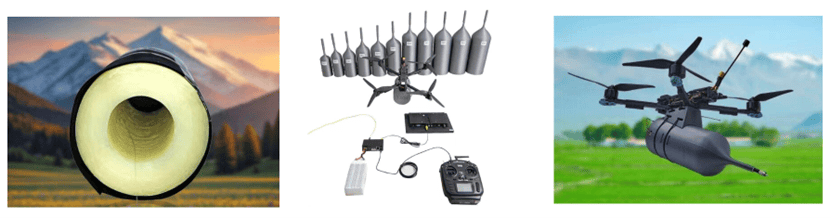
HOLIGHT’s fiber reel systems are engineered for professional tethered UAV applications, integrating robust mechanical design and superior optical performance.
Structural Design
- Lightweight carbon-aluminum housing for portability
- Kevlar-reinforced hybrid cable for high tensile strength (>1500N)
- Built-in slip ring ensuring stable rotation
- Waterproof & dustproof (IP65–IP68 options)
- Plug-and-play fiber connector interfaces (LC/APC, SC/APC, or MPO)
Main Technical Parameters
| Parameter | Specification |
|---|---|
| Fiber Type | Singlemode G.657.A2 or OM3 Multimode |
| Length Options | 1 km to 60 km |
| Outer Diameter | 2.8–5.0 mm |
| Tensile Strength | ≥1500 N |
| Operating Temperature | -40°C ~ +85°C |
| Attenuation | ≤0.35 dB/km @1310 nm |
| Bending Radius | ≥15 × cable diameter |
| Connector Type | LC/APC, SC/APC, MPO |
| Power Pair | 2 × 1.5 mm² Copper |
For detailed specs and customization, visit
👉 HOLIGHT Fiber Reel System
Real-World Applications
- Urban Surveillance
Deployed on mobile command vehicles, fiber-tethered drones can transmit 4K real-time video to control centers for crowd management, traffic monitoring, or law enforcement.
- Disaster Response
When cellular networks fail, tethered UAVs act as temporary communication relays, providing instant LTE/5G coverage and visual mapping for emergency teams。
- Energy & Infrastructure Inspection
Wind farms, power lines, and oil pipelines benefit from long-duration monitoring — the fiber tether ensures interference-free telemetry over vast distances.
- Military & Defense
Fiber tethers offer zero electromagnetic leakage, ideal for reconnaissance and secure communication missions where stealth is crucial.
Installation & Maintenance Tips
Proper cable handling and maintenance are essential to extend the lifespan of tethered drone systems and ensure consistent performance.
- Avoid Sharp Bends:
Maintain a bending radius ≥15× the cable diameter to prevent micro-bending losses. - Clean Connectors Regularly:
Use fiber cleaning pens or lint-free swabs before every mission; even minor dust particles can increase attenuation. - Tension Monitoring:
Ensure the reel maintains constant tension during winding and unwinding to prevent internal fiber stress. - Environmental Care:
After outdoor use, wipe the reel surface to remove sand, salt, or moisture; store in a cool, dry case. - Routine Testing:
Perform OTDR and power-meter checks every 6–12 months to monitor link integrity and identify early degradation.
📌 By following these practices, operators can significantly reduce downtime and maintain optimal UAV performance during continuous missions.
Why Fiber Beats Wireless
| Parameter | Fiber Tether System | Wireless 5G Drone |
|---|---|---|
| Latency | <1 ms | 20–100 ms |
| Bandwidth | Up to 100 Gbps | 1–2 Gbps typical |
| Interference | None (EMI immune) | Weather and congestion sensitive |
| Stability | Continuous | Signal drops possible |
| Operating Time | Unlimited (wired power) | 20–40 minutes |
| Deployment | Fixed or vehicle-based | Free-flight only |
👉 Result: Fiber tether drones outperform wireless UAVs in every critical metric — stability, endurance, and data fidelity.
Future Outlook
The global tethered UAV market is projected to grow at CAGR 11–13% (2025–2030), driven by defense modernization, smart cities, and AI-enhanced aerial analytics.
Emerging directions include:
- AI-assisted surveillance using onboard edge processors.
- Autonomous tethered networks where multiple UAVs coordinate coverage.
- Hybrid power + data reels supporting both fiber optics and fast-charging conductors.
As the need for persistent, high-bandwidth aerial systems rises, fiber reels will remain the backbone of tethered drone infrastructure worldwide.
FAQ
- What is the purpose of a fiber optic tether in UAVs?
It supplies both power and high-speed data link to keep drones airborne for extended missions. - How long can tethered drones operate?
With fiber tethers, drones can stay in flight continuously for 24–72 hours or more. - What fiber types are used in drone tethers?
Typically G.657.A2 (bend-insensitive singlemode) or OM3/OM4 multimode for shorter links. - Can fiber tethers handle both data and power?
Yes. Hybrid designs integrate copper conductors for power and optical fibers for data. - Are Starmile fiber reels customizable?
Yes — lengths, connectors, reel materials, and hybrid configurations can be fully OEM/ODM tailored. - What’s the maximum reel length?
Up to 60 km depending on fiber type and application environment. - Are these reels suitable for outdoor or marine use?
Yes. HOLIGHT offers IP67/IP68 waterproof reels with anti-corrosion housing for harsh environments.