

Introduction: Why APC Does Not Replace UPC as the Industry Standard
The APC (Angle Polished Connector) has been found to provide better return loss than the UPC (Ultra Polished Connector). Why aren’t all fiber optic connectors made with an APC?
The return loss of a fiber optic network is a critical parameter-especially in networks with signal reflections-the return loss specification is important for determining the quality of the transmission, or how much of the optical signal returns to the source, thereby potentially destabilizing the link.
An APC (Angle Polished Connector) has a typical return loss of greater than 60dB.
An UPC (Ultra Polished Connector) has a typical return loss of greater than 50dB.
It would be logical to expect, therefore, that since an APC offers better performance than an UPC; the industry would have adopted an APC connector as a standard. The reality, however, is that there is no single reason why APC does not dominate the market; instead, the selection of APC versus UPC depends on multiple factors, including application requirements (cost versus performance), the need for compatibility with existing equipment (legacy systems), and operational considerations.
The choice of components in fiber optic engineering is not merely to find the “best” component; rather, it is to choose the “right” component for the overall fiber optic system.
Basic Technical Differences Between APC and UPC Connectors
To further appreciate the differences between APC’s and UPC’s, one must first understand the basic technical differences between the two types of connector:
An UPC connector has a slightly convex (“curved”) polished end-face to reduce air gaps and Fresnel reflections; whereas,
An APC connector has an 8-degree angled polished end-face that directs returning light into the cladding instead of back towards the source laser.
The geometry created by the angled-end face of the APC connector allows for very low back reflection, and therefore makes APC connectors essential for use in optical systems that are sensitive to reflection.
Application Scenarios Define the Actual Requirement (Most Important Consideration)
FTTH and PON Systems
Splitters in the PON area of a FTTH deployment cause significant downstream signal power reduction and allow multiple upstream signals onto the same fiber. Therefore, the smallest reflections can harm the upstream transmission, while also adding noise to the OLT.
This means the application of the APC connector is non-negotiable throughout the access network, from the OLT port to the ONU interface, as the APC connector will keep any reflections as low as possible.
CATV (Cable Television) Systems
Also, due to their nature, analog signals are much more sensitive to reflections than digital signals. The quality of an analog signal is degraded by the introduction of nonlinear distortion elements caused by reflections.
As a result, the introduction of the following distortion elements is commonplace in CATV systems:
CSO (Composite Second Order)
CTB (Composite Third Beat)
All of the impairments stated above appear on the viewer’s end as: snow; ghosting; or image distortion. The use of APC connectors in these systems is non-optional and therefore, essential.
High-Speed Coherent Optical Transmissions
With the recent introduction of 100G, 400G, and beyond, coherent modulation formats require very high signal-to-noise ratios. Backreflection can have the effect of interacting with a laser source and local oscillator causing increased phase noise and degrading the system margin.
When minimizing these artifacts, APC connectors continue to be used more frequently in scenarios requiring critical reflection also.
Where UPC Connectors Will Suffice
Reflection-Tolerant Environments – Data Centers
Typically in the data center environment, the distance of the fiber links between the switch and the servers is short; the power budgets at the data center are high; and the transceivers used have been designed to accommodate moderate reflection.
For this reason, the performance of UPC connectors has exceeded the requirements of the data center environment. Practically, besides the additional costs and decreased interchangeability of your equipment, the APC design does not provide any additional operational benefits.
Most enterprise and campus environments utilize digital-data transmission systems where the only time that reflection (return loss) will become a concern is if it exceeds the receiver’s vast shut-off range.
For this reason, if you are using UPC connectors, which offer greater than -50 dB of return loss, you will not have to worry about excessive return loss damaging your data or network infrastructure.
As with any engineering discipline, it is advisable to eliminate unnecessary complexity from any product. Therefore, when evaluating your connectivity options for digital-data transmission, the UPC design is consistent with this guideline.
Mechanical Complexity vs. Manufacturing Costs
The manufacturing processes necessary to produce APC connectors are much longer and more complicated than those used to manufacture UPC connectors, resulting in an increased manufacturing cost.
The method used for polishing end faces is much more elaborate for APC connectors than for UPC connectors because the angle of the end face requires an 8-degree angle.
The higher rejection rates caused by APC connector production (more complex polishing operations with tighter controls) result in a much lower manufacturing yield.
APC connector designs are more complex due to the need to provide keyed interfaces and anti-mismatch features.
Consequently, all these factors make APC connectors much more expensive to produce than UPC connectors. On a large scale (e.g., connecting a data center), the difference in price becomes a significant financial burden without commensurate benefits in terms of system-level performance.
Compatibility and Interoperability Issues
Mixing APC and UPC connectors is not allowed; this is one of the most important points about these connector types that is frequently missed or ignored.
An APC connector should never be mated with a UPC connector.
If an APC Connector is inserted into a UPC Connector, the following problems will occur:
Significant air gap
Extremely high insertion loss
Severe uncontrolled reflections
Potential permanent damage to the ferrule end faces
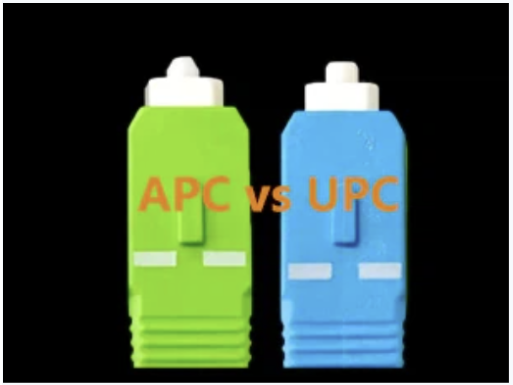
In order to avoid accidental mismatch, connectors with an Angled Physical Connection (APC) use green housings and distinct keying, while those with a Uniform Physical Connection (UPC) usually use blue.
The ecosystem surrounding the UPC connector is linear; all network components (Transceiver, Patch Panel, Jumper, and Test Equipment) are almost always designed to work with the UPC interface.
When moving an existing UPC-based infrastructure to APC, you will need to change out a large number of installed components, which will not only cost money, but it will also not be a justifiable technical effort in a reflection-tolerant system.
Cleaning, Inspection, and Maintenance Considerations
Proper cleaning and inspection are necessary for all types of connectors; however, APC Connectors have added challenges in the area of inspection.
First, the angle of the end face of an APC Connector causes the inspection light to redirect away from the microscope.
Second, without the proper tools and experience, it will be more difficult to detect contamination and scratches.
Third, field technicians will need to be trained properly in order to correctly inspect and verify the end faces of an APC Connector.
The inspection process of a UPC Connector can be visually inspected easier and thus, may require less time to maintain and have less opportunity for error in a high-density work environment.
APC vs. UPC: Practical Comparison
UPC Connectors have a slightly convex end-face, so they return >50 dB
APC Connectors have an 8-degree angled end-face with a return loss >60 dB
UPC Connectors provide some suppression of reflections
APC Connectors provide extremely high reflection suppression
Typical applications:
UPC Connectors: Data Centres, LANs, Enterprise Networks
APC Connectors: Fibre-To-The-Home (FTTH), Cable TV (CATV), Coherent Optics
In order to compare prices, UPC Connectors are cheaper than APC Connectors; however, UPC and APC are not interchangeable as they are not compatible.
Engineering Perspective: Best Performance vs. Best Choice
From an Engineering perspective, the term “Best Performance” does not refer to what would be called “Best Choice”.
A common error in the design of fibre optic networks is to assume that wherever the highest-performing components should be used; however, this assumption creates over-engineering, inflated costs, and increased operational risk.
The fact that both APC and UPC Connectors continue to be coexisting indicates a more mature Engineering philosophy surrounding Duplex Connectors:
APC Connectors should be used where reflections are impacting system performance
UPC Connectors should be used where reflections are not affecting user experience and are efficient and economical
There is a direct correlation between the Engineering philosophy of “Application-Driven Design” in terms of Reliability, Cost Efficiency and Long-Term Maintainability-key goals of designing Optical Networks today.
Final Conclusion
APC Connectors clearly outperform UPC Connectors in terms of return loss; however, Optical Networks should be treated as Systems, not individual components.
Therefore, when determining performance, all performance must be viewed in context.
If reflection is impeding the growth of the signal being transmitted across the Connector, then an APC Connector should be the choice.
When reflections are not impeding the growth of the signal being transmitted from one Connector to another, then use of an UPC Connector should be the right choice based on Cost, Practicability and Interoperability.
The reason both Standards have a place in the Industry is due to sound engineering judgment.