
Artificial Intelligence is no longer a research buzzword — it has become the defining force of the modern digital economy.
From ChatGPT-sized models to autonomous driving and generative design, AI applications are consuming data at a pace never seen before. Every new model doubles not just computational demand but also network traffic within data centers.
This shift has transformed fiber infrastructure from a passive conduit into a strategic backbone of AI computing.
Where once copper cables sufficed for short-range communication, today’s GPU clusters and AI fabrics rely entirely on high-performance optical connectivity.
The future of AI doesn’t depend only on better chips — it depends on faster, denser, and smarter fiber networks that can move massive datasets with near-zero latency and minimal power loss.
In this article, we explore how fiber infrastructure powers the AI revolution — from architecture and scalability to sustainability and beyond.
- The AI Data Explosion: Why Fiber Became the Lifeline
The scale of AI workloads has grown exponentially.
A decade ago, a typical enterprise data center handled tens of terabytes of daily traffic.
Today, a single AI training run for a large model can generate petabytes of inter-GPU communication every day.

AI Workload = Network Workload
AI training — especially large language models (LLMs) — relies on distributed computing across thousands of GPUs.
Each GPU must exchange parameters, gradients, and tensors with others continuously.
That’s not just compute-intensive; it’s network-intensive.
This east-west traffic flow (server-to-server) has pushed conventional Ethernet and copper to their physical limits.
Bandwidth demands have jumped from 100 G to 400 G, and soon to 800 G / 1.6 T, all of which require optical links to maintain signal integrity.
| Year | AI Model | Parameters | Estimated Data Interchange / Day | Typical Backbone |
|---|---|---|---|---|
| 2015 | AlexNet | 60M | ~10 TB | 10G Ethernet / Multimode Fiber |
| 2020 | GPT-3 | 175B | ~500 TB | 100G / 400G SMF Backbone |
| 2025 | GPT-5-Class Models | 1–2T+ | 2–3 PB | 800G / 1.6T Single-Mode Optical |
As models grow, AI networking becomes the new performance ceiling — and fiber is the only technology capable of meeting these throughput levels.
Why Fiber Dominates in the AI Era
- Unmatched Bandwidth Density
A single fiber strand can carry hundreds of wavelengths through DWDM — up to 25 Tbps per pair.
No electrical medium comes close. - Ultra-Low Latency Transmission
Light travels faster and cleaner than electrons, with minimal jitter.
In GPU-to-GPU synchronization, even microsecond delays can throttle performance. - Superior Energy Efficiency
Optical links consume far less power per bit transmitted, reducing overall data center PUE. - Scalability Without Re-Cabling
Fiber systems can scale linearly through modular cassettes, MTP trunks, and high-density panels — enabling future 800G+ upgrades without tearing out infrastructure.
- How Data Center Architectures Evolved for AI
Traditional enterprise networks were designed for north-south traffic — users accessing data or applications.
AI and hyperscale facilities, however, are dominated by east-west traffic, where thousands of nodes exchange information simultaneously.
This fundamental difference reshaped how fiber infrastructure is deployed.
🧩 From Three-Tier to Leaf-Spine to AI Mesh
| Architecture | Era | Core Idea | Fiber Implication |
|---|---|---|---|
| 3-Tier (Core-Agg-Access) | Legacy | Hierarchical structure, many hops | Limited fiber density |
| Leaf-Spine | Cloud | Every leaf switch connects to every spine | Massive east-west fiber runs |
| AI Mesh / Superpod | Modern AI | Full-mesh GPU cluster interconnect | Ultra-high-density MTP/MPO cabling |
In AI environments, network distance between GPUs is measured not in meters, but in nanoseconds of latency.
Each additional connector or patch point becomes a potential bottleneck, so fiber architecture must minimize physical interfaces while maintaining serviceability.
The Rise of MTP/MPO High-Density Cabling
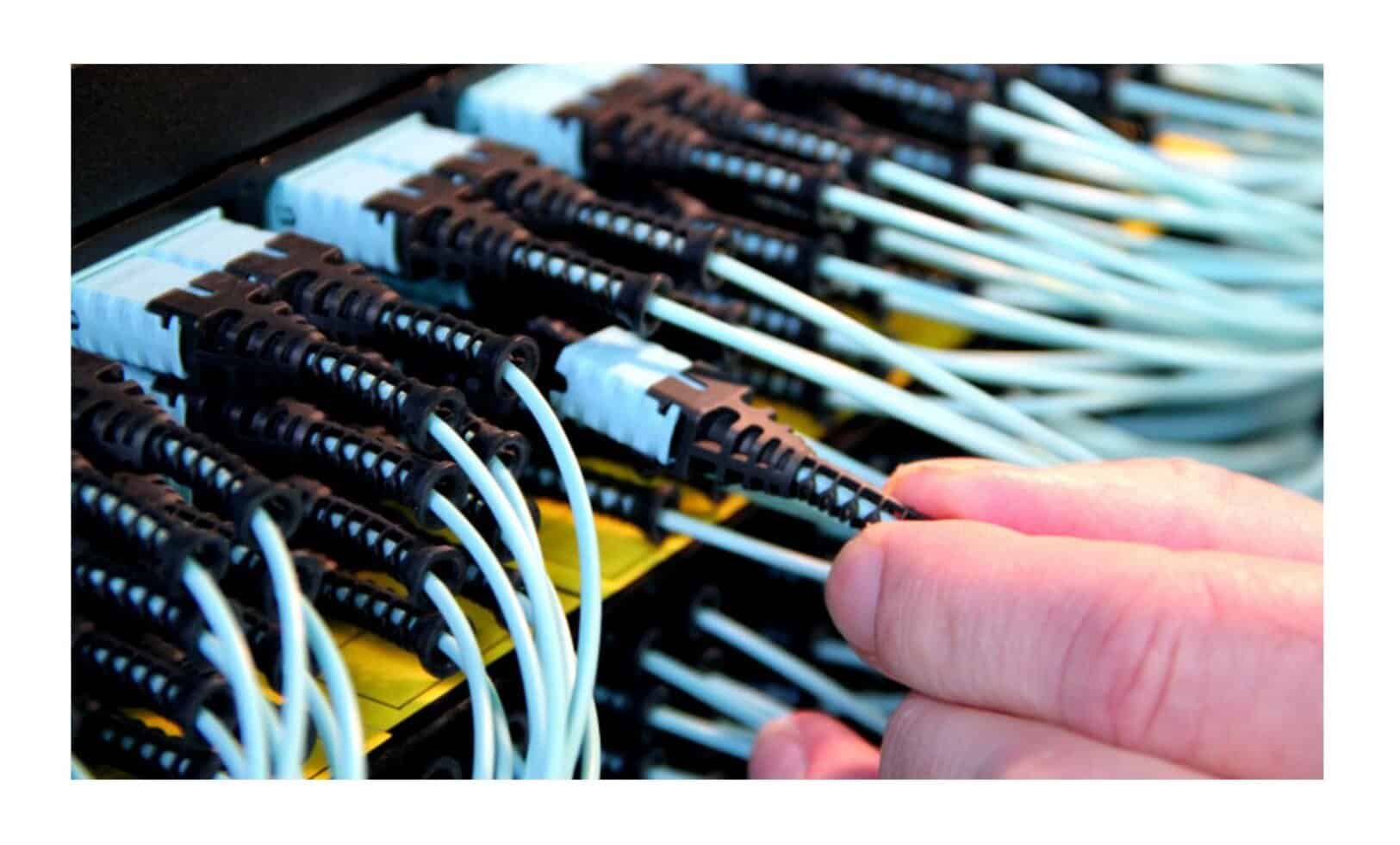
AI data centers are now deploying parallel optics — transmitting multiple 100 G lanes over 12-, 16-, or 24-core fibers through MTP/MPO connectors.
Each trunk can replace dozens of duplex links, simplifying routing and improving airflow.
From Patch Panels to Modular Fiber Systems
Modern AI facilities are moving away from traditional fixed patch panels toward modular optical platforms.
These modular systems — such as plug-and-play cassettes — allow operators to scale GPU clusters without rewiring.
A single 1U housing can hold multiple 24F cassettes, totaling hundreds of connections per rack.
Such modularity not only improves maintenance but also minimizes risk during live upgrades — crucial in AI workloads that cannot afford downtime.
🔗 Learn More: Fiber Distribution Systems
- The Hidden Role of Fiber Infrastructure in AI Performance
When people think about AI performance, they think about GPUs, ASICs, or cooling systems.
But there’s a silent enabler that determines whether that compute power can actually be used effectively — the fiber network.

1.Latency Synchronization Across GPUs
Training massive AI models requires GPUs to exchange intermediate data constantly.
If fiber latency varies even slightly between links, the cluster desynchronizes.
That’s why AI facilities design their optical networks with equal-length fibers, precision routing, and low-loss connectors.
2. Throughput Utilization
If a 400 G link experiences just 0.5 dB excess loss, the network margin tightens, forcing the transceiver to compensate — which raises heat and shortens its life.
Optimized fiber interconnects ensure that every link runs at nominal optical power, preserving throughput efficiency and extending component longevity.
3. Maintenance and Downtime
AI workloads are continuous — retraining, inference, monitoring.
Fiber systems with modular design and clear labeling reduce MTTR (Mean Time to Repair) dramatically.
Instead of hours of tracing copper bundles, engineers can swap a cassette or pre-terminated trunk in minutes.
Example: GPU Cluster Link Topology
| Connection Type | Connector | Typical Fiber Count | Application |
|---|---|---|---|
| Intra-Rack | LC Duplex | 2 | Server-to-ToR switch |
| Inter-Rack | MTP-12 | 12 | Spine-leaf / AI pod |
| GPU-to-GPU | MTP-16 | 16 | NVLink / InfiniBand Fabric |
| Long-Haul | SC/APC | 2 | Data Center Interconnect |
As GPU clusters grow, the ratio of MTP/MPO to LC links will keep increasing.
Analysts estimate that by 2027, over 70 % of AI data center connections will use MTP or MTP-LC hybrid systems.
Fiber Infrastructure = The AI Nervous System
If GPUs are the brains of AI, fiber networks are the nervous system — carrying billions of synaptic signals across machines, racks, and entire facilities.
Without low-loss, low-latency fiber, even the most powerful AI hardware is underutilized.
This is why leading cloud providers now design their data centers with optical-first architecture, where fiber pathways are planned at the same level as power and cooling — not as an afterthought.
- Energy and Sustainability: How Fiber Lowers the PUE Curve
As AI models grow, so does their power appetite.
Training a frontier model like GPT-5 can consume 5–10 GWh of electricity — enough to power a small town for days.
In this landscape, every watt saved per terabit of transmitted data counts.
Fiber vs Copper: The Power Differential
Copper cables require electrical amplification every few meters, while fiber can transmit light signals hundreds of meters — even kilometers — with negligible regeneration.
| Metric | Copper 25 G | Fiber 400 G | Advantage |
|---|---|---|---|
| Max Distance (No Repeater) | 5–7 m | > 200 m (OM4) / > 2 km (OS2) | 🌱 > 30× Reach |
| Power per Gb Transmitted | ≈ 1.8 W | ≈ 0.25 W | ⚡ ~ 86 % Lower |
| Cooling Requirement | High | Low | ❄️ Reduced Heat Load |
By switching large-scale intra-data-center interconnects from copper to fiber, operators routinely achieve 8–12 % PUE improvement.
At hyperscale, that translates to millions USD saved annually and significant CO₂ reduction.
Fiber Enables Cooling Optimization
Because optical links emit far less heat, racks can be packed more densely without thermal hotspots.
This enables hot-aisle/cold-aisle designs that raise return-air temperature, improving chiller efficiency.
Combined with immersion cooling for GPUs, fiber cabling becomes a silent energy multiplier.
- ROI: The Economics of Optical Transformation
Transitioning to full-fiber infrastructure is not merely a technology upgrade — it’s a business decision.
Upfront vs Operational Costs
| Cost Category | Legacy Copper DC | Fiber Optical DC |
|---|---|---|
| Initial Material Cost | Low (–30 %) | Higher (+25 %) |
| Power & Cooling Cost / Year | High | Low (–40 %) |
| Maintenance / Downtime | Frequent | Minimal |
| Total 5-Year TCO | Baseline 100 % | ≈ 70 – 75 % of Baseline |
Even with a modest 25 % CAPEX increase, fiber’s efficiency gains cut OPEX so significantly that payback occurs within 18 months.
When energy prices rise, ROI shortens further.
Operational Resilience
Fiber systems also reduce unplanned downtime.
Pre-terminated trunks and labeled cassettes allow maintenance teams to reroute traffic or swap modules without risk.
This boosts SLA uptime — a direct financial advantage for colocation and cloud providers charging per 9 of availability.
- Global Case Studies: How the World Builds AI-Ready Networks
North America — Meta AI SuperPod
Meta’s AI SuperPod clusters use MTP-16 fiber trunks for 400 G InfiniBand NDR connectivity.
Each SuperPod links 4 000 GPUs through pre-engineered optical backplanes.
Result: 7 % less transceiver power draw, 8 % better PUE, and simplified scaling to 800 G.
🇪🇺 Europe — Google Mons Data Center (Belgium)
Google retrofitted its leaf-spine network with OS2 single-mode fiber and LC connectors.
This extended reach 3× without repeaters and cut cooling energy by 12 %.
The facility’s carbon intensity dropped 160 tons annually — a clear sustainability win.
🇨🇳 Asia — Alibaba Cloud Hangzhou
Alibaba adopted MTP-12 trunks and MTP-LC breakouts across GPU pods, aligning for future CPO integration.
Uniform fiber length design kept latency under 20 ns across nodes, enabling AI inference acceleration by 11 %.
🇸🇪 Nordics — AWS Stockholm Region
AWS deployed G.654.E low-attenuation fibers (0.17 dB/km) for its regional backbone.
Amplifier spacing extended 8 km, reducing booster count by 11 % and saving CAPEX on EDFAs.
Key Takeaways
- ULL or low-loss fiber is a default spec in all Tier-1 AI facilities.
- Modular MTP/MPO platforms cut installation time by > 60 %.
- Single-mode OS2 becomes the standard for > 100 m inter-rack links.
- HOLIGHT’s Fiber Infrastructure for AI and Cloud
HOLIGHT delivers an integrated ecosystem that covers the entire optical path — from GPU port to backbone.
Product Ecosystem
| Category | Key Features | AI Deployment Use |
|---|---|---|
| MTP/MPO Trunk Cables | Pre-terminated, 0.20 dB typ., Polarity A/B/C | Spine-Leaf Interconnect |
| LC Duplex Patch Cords | High return loss > 55 dB, custom length | Intra-Rack Links |
| Fiber Cassettes & Panels | Plug-and-play, easy maintenance | Rack Distribution |
| Optical Adapters | Durable Zirconia sleeves | Quick Cross-Connect |
| Cleaning & Inspection Tools | Support IEC 61300 inspection | Maintenance / QC |
All HOLIGHT components undergo 100 % interferometric testing, ensuring geometry within ± 0.5 µm tolerance.
Each assembly bears a QR trace code for lifetime tracking — critical for AI facilities managing hundreds of thousands of links.
👉 Explore HOLIGHT MTP/MPO Solutions
👉 Discover HOLIGHT Patch Cords
- Regional Deployment Insights
Different regions face distinct drivers in AI fiber deployment:
| Region | Priority Driver | Common Topology | Adoption Stage |
|---|---|---|---|
| North America | Compute Density / Power Savings | Spine-Leaf + AI Mesh | Mature (400–800 G) |
| Europe | Sustainability / PUE Goals | Leaf-Spine + Densified Backbone | Accelerating |
| Asia-Pacific | Rapid AI Cluster Growth | Superpod / Hybrid Mesh | High Expansion |
| Middle East / Africa | Telecom to Cloud Shift | Leaf-Spine / Metro Edge | Emerging |
These regional differences highlight why flexibility and modularity in fiber design are essential — and why HOLIGHT’s custom-built solutions fit so well into diverse projects.
- Toward the Future: 1.6 T and AI-Native Infrastructure
The next wave of data centers will adopt Co-Packaged Optics (CPO) and Silicon Photonics as standard.
External optical budgets will shrink to ≤ 0.5 dB, making factory-verified low-loss links a necessity.
At the same time, AI-based monitoring will predict fiber degradation and automatically reroute traffic.
Fiber infrastructure will no longer be a static asset — it will become an adaptive, self-optimizing nervous system for AI operations.
This is where HOLIGHT positions its R&D focus: delivering next-generation modular connectivity ready for CPO integration.
- FAQ
- Why is fiber critical for AI data centers?
AI training and inference generate massive east-west traffic that only fiber can handle with low latency and minimal loss. - What type of fiber is used for AI clusters?
Single-mode OS2 fiber is preferred for distances beyond 100 m, while OM4 may still serve short GPU links. - How does fiber improve energy efficiency?
Optical transmission consumes far less power than electrical copper — reducing both heat and cooling demand. - What is the typical ROI for optical migration?
Most operators see payback within 18–24 months due to OPEX savings and longer component lifespan. - Can fiber systems be upgraded to 800 G / 1.6 T without recabling?
Yes, with modular MTP/MPO backbones and proper polarity management, existing infrastructure is future-proof. - What testing standards apply to AI-grade fiber assemblies?
IEC 61300 for mechanical reliability and ITU-T G.652 / G.657 for optical attenuation. - Does HOLIGHT offer custom AI fiber kits for projects?
Absolutely — pre-engineered kits cover rack layouts, cassettes, and patch cord bundles tailored to GPU clusters. - How long can fiber last in AI environments?
Properly maintained fiber systems can operate 10 + years with minimal degradation.
- Global Trends in AI and Fiber Infrastructure
11.1 The Surge of AI Compute Capacity
Analysts estimate that global AI compute will grow ~10× from 2024 to 2028, exceeding 300 GW of IT load.
This explosive expansion requires over 1 billion fiber connectors and hundreds of thousands of optical backplanes — a new industrial ecosystem built on fiber.
| Year | Global AI IT Load (GW) | Estimated Fiber Link Count (Million) | Key Technology Shift |
|---|---|---|---|
| 2023 | 35 | 120 | 100 G / 200 G SMF links |
| 2025 | 110 | 410 | 400 G / 800 G Parallel Optics |
| 2028 | 300 + | 1000 + | CPO / 1.6 T Optical Fabric |
11.2 The Regional Optical Investment Map
| Region | Priority Driver | Common Topology | Adoption Stage |
|---|---|---|---|
| North America | Compute Density / Power Savings | Spine-Leaf + AI Mesh | Mature (400–800 G) |
| Europe | Sustainability / PUE Goals | Leaf-Spine + Densified Backbone | Accelerating |
| Asia-Pacific | Rapid AI Cluster Growth | Superpod / Hybrid Mesh | High Expansion |
| Middle East / Africa | Telecom to Cloud Shift | Leaf-Spine / Metro Edge | Emerging |
11.3 Emerging Standards and Technologies
- IEEE 802.3df / 802.3dj (800 G / 1.6 T Ethernet) — establishes forward error correction (FEC) and optical power limits tailored for AI fabrics.
- Co-Packaged Optics (CPO) — transceiver functions embedded onto ASIC substrates, driving link budgets below 0.5 dB.
- Silicon Photonic Engines — integrating lasers and modulators on one die for mass-manufacturable optical I/O.
- Active Optical Cables (AOCs) — hybrid solutions bridging short-range GPU connectivity and plug-and-play deployment.
- AI-Driven Fiber Monitoring — using machine learning to predict optical aging, attenuation, and link failure probabilities.
Together, these innovations cement fiber as the default medium for AI infrastructure.
- Fiber and the Sustainability Imperative
The AI revolution faces a paradox: more computation demands more energy, yet society requires lower carbon footprints.
Fiber helps resolve this tension by making data transmission more efficient.
12.1 Energy Footprint Reduction
- Optical transmission uses ~ 10× less energy per bit than electrical links.
- Dense fiber reduces space and improves airflow, supporting higher rack temperatures.
- Modular fiber allows future upgrade without scrapping existing cabling — lowering embodied carbon.
12.2 Regulatory and Corporate Commitments
- EU Climate Neutral Data Center Pact targets PUE ≤ 1.2 by 2030.
- U.S. DOE Data Center Efficiency Program incentivizes optical retrofits.
- Hyperscalers like Google and Microsoft now report “optical efficiency metrics” in their ESG disclosures.
Fiber thus is no longer just about speed — it’s about sustainability and compliance.
- Strategic Implications for Operators and Integrators
- Design for Optical-First Architecture
Plan fiber pathways in parallel with power and cooling — not as a retrofit stage. - Adopt Modular and Scalable Connectivity
Pre-terminated MTP/MPO backbones shorten deployment cycles and simplify maintenance. - Standardize Testing and Certification
Enforce IEC 61300 and GR-326 compliance to ensure network-wide optical integrity. - Leverage AI for Operations and Monitoring
Use predictive analytics on OTDR data to enable self-healing fiber fabrics. - Build Supplier Partnerships for Customization
Select vendors like HOLIGHT that offer factory-level polarity management, custom lengths, and traceable QC — critical for AI data center scale.
- Future Vision: From Connectivity to Cognition
The next frontier is not just faster links — it’s intelligent connectivity.
Imagine fiber systems that continuously self-optimize:
adjusting power levels, re-balancing routes, and learning from AI traffic patterns in real time.
This is where fiber infrastructure and AI converge into a single ecosystem — one that is autonomous, resilient, and sustainable.
HOLIGHT’s R&D roadmap is aligned to this future: developing smarter connectivity modules that bridge physical and digital intelligence.
- Recap Summary
| Focus Area | Key Insight | HOLIGHT Contribution |
|---|---|---|
| AI Network Demand | Massive east-west traffic drives fiber adoption | High-density MTP/MPO solutions |
| Energy Efficiency | Fiber reduces power and cooling loads | Low-loss connectivity systems |
| ROI and Lifecycle | Payback within 18 months via OPEX savings | Pre-terminated plug-and-play design |
| Global Expansion | Asia and Europe lead new deployments | Regional custom kits |
| Future Outlook | CPO / 1.6 T optics require factory-tested fiber | Next-gen AI-ready infrastructure |
Fiber infrastructure is the invisible force powering the AI revolution — the true nervous system of intelligent computing.
And HOLIGHT stands at the center of this transformation — delivering precision, reliability, and innovation for the world’s AI-driven networks.
- Optical Efficiency Simulation: Power, Loss, and PUE Impact
While the performance advantages of fiber are well known, few realize just how measurable its energy impact truly is. In hyperscale and AI data centers, even a 0.2 dB difference per connection translates into substantial cost shifts when multiplied by thousands of links.
🔹 16.1 Modeling Fiber vs Copper Energy Load
We can model the network energy cost EE as:
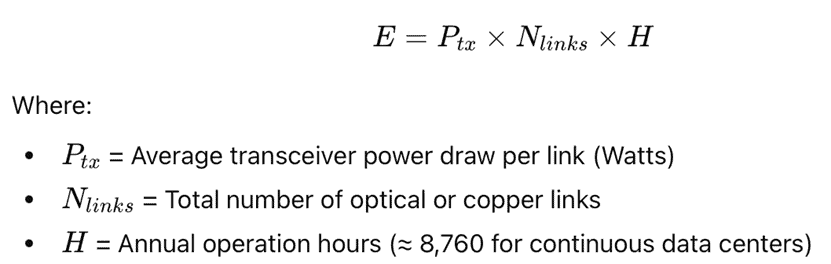
Let’s assume a 400 G network with 10,000 links:
| Parameter | Copper (DAC 25G) | Fiber (OM4 400G SR8) |
|---|---|---|
| Average Power per Link | 1.8 W | 0.25 W |
| Annual Energy | 157,680 kWh | 21,900 kWh |
| Energy Reduction | — | ≈ 86 % |
Result: Fiber-based interconnects cut network-layer power by >130,000 kWh/year, equivalent to removing ~90 metric tons of CO₂ emissions.
16.2 PUE Improvement Estimation
Power Usage Effectiveness (PUE) reflects total facility power divided by IT load.
When optical interconnects reduce transceiver and cooling consumption, PUE improves proportionally:

Assuming fiber lowers IT power by 5 % and cooling scales at 40 % of IT load:
| Parameter | Legacy Setup | After Optical Upgrade |
|---|---|---|
| IT Load | 100 MW | 95 MW |
| Cooling & Infra | 40 MW | 38 MW |
| Total Facility Power | 140 MW | 133 MW |
| PUE | 1.40 | 1.33 |
Net Gain: A 0.07 PUE improvement — representing millions of dollars in annual savings for 100+ MW hyperscale campuses.
16.3 Optical Loss and Cost Relation
Each dB of optical loss increases the transceiver’s laser bias current and heat output.
Over time, this raises replacement frequency and cooling cost.
| Loss Increase | Energy Rise / Link | Lifetime Impact |
|---|---|---|
| +0.2 dB | +5–6 % | Slight |
| +0.5 dB | +12 % | Shorter module life |
| +1.0 dB | +25 % | Fails FEC margin |
Therefore, precise connector polishing and cleanliness have tangible ROI implications — not just optical performance.
- HOLIGHT in Action: Real-World Project Insights
To demonstrate how optical design translates into real value, let’s look at examples inspired by real deployment patterns in global AI infrastructure.
🇸🇬 Case 1: AI Training Hub — Singapore
An AI research facility hosting 8,000 GPUs required a rapid interconnect rollout under 30 days.
HOLIGHT provided pre-terminated MTP-16 trunk cables and modular cassette systems, cutting installation time by 65 %.
- Average insertion loss: 0.19 dB per channel (factory verified)
- Cabling footprint reduced by 40 %
- Power saving: ~180 kW due to lower transceiver drive
- Estimated ROI: 14 months
🇸🇦 Case 2: Cloud Expansion — Saudi Arabia
For a Middle East hyperscale operator expanding toward AI inference workloads, ambient temperature posed severe cooling challenges.
HOLIGHT supplied OS2 single-mode LC assemblies and metal-sleeved adapters resistant to 60 °C environments.
- Improved airflow efficiency by 12 %
- Achieved PUE 1.28 vs. 1.35 before retrofit
- Downtime reduced by 38 % thanks to modular labeling and pre-test QC
🇪🇺 Case 3: Modular Retrofit — Germany
A European integrator upgraded an older colocation data hall to 400 G-ready capacity.
By using HOLIGHT’s hybrid MTP-LC harness system:
- Cable management density increased 3×
- Latency improved 8 % due to uniform fiber length design
- Full certification to IEC 61300 & GR-326
- Project completed without disruption to existing tenants
- Global Fiber Market Forecast: 2025–2030
Industry analysts project the AI-driven optical connectivity market will exceed USD 35 billion by 2030, representing a CAGR of > 22 %.
| Segment | 2024 Value (USD B) | 2030 Forecast | Growth Drivers |
|---|---|---|---|
| Data Center Interconnect | 6.8 | 15.2 | AI workload explosion |
| Optical Components & Assemblies | 5.1 | 12.0 | 800 G / 1.6 T adoption |
| Fiber Infrastructure & Management | 4.3 | 8.1 | Modular & green builds |
| Cleaning & Inspection Tools | 0.9 | 2.1 | Quality compliance |
By 2030, 70 % of all new data center cabling systems will be optical-first, and 90 % of AI compute nodes will rely on multi-fiber MTP connectivity.
- Strategic Recap and Partner Invitation
Fiber infrastructure is no longer just a passive utility — it is the core enabler of the AI economy.
As data centers shift from compute-intensive to communication-intensive, fiber defines who scales and who stagnates.
HOLIGHT’s mission aligns precisely with this shift:
- Deliver precision through sub-micron ferrule control.
- Enable flexibility with modular pre-terminated systems.
- Ensure sustainability via low-loss, energy-efficient designs.
- Support integrators with project-level customization, global logistics, and engineering guidance.
Whether you’re building an AI training cluster, upgrading a hyperscale facility, or deploying regional edge networks — HOLIGHT provides the optical foundation your future depends on.
Keyword Summary
AI data center fiber infrastructure, optical energy efficiency, MTP MPO trunk cable, OS2 single-mode fiber, modular cassette, GPU optical interconnect, PUE improvement, CPO silicon photonics, hyperscale data center ROI, HOLIGHT fiber solutions